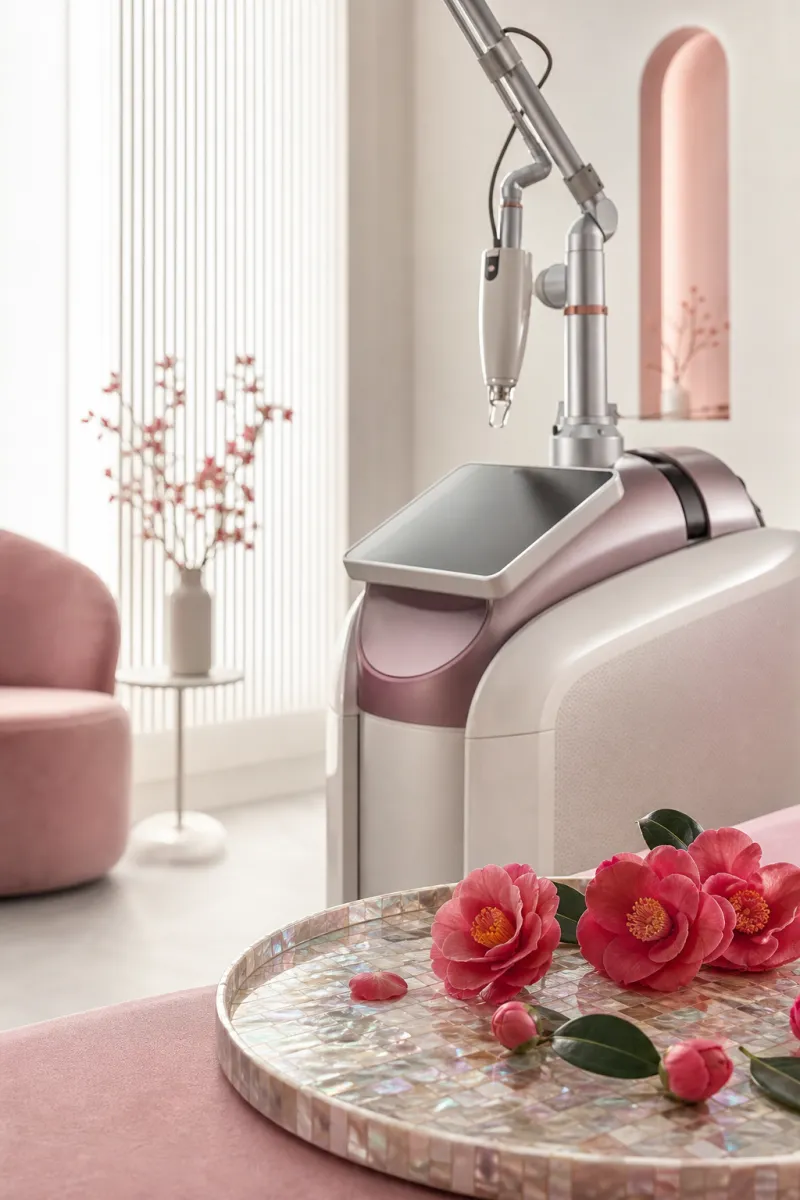
A Seoul laser skin clinic usually handles brown pigment with two separate tools: low-fluence Q-switched Nd:YAG toning for blotchy, diffuse tone, and a 755 nm alexandrite spot laser for distinct sun spots. A toning pass lasts roughly 10 to 20 minutes and seldom needs numbing. Spot work is quicker, yet each treated mark darkens and forms a thin crust that sheds in about a week. Pinkness after toning settles within hours to a few days, so a same-day flight home is generally possible after either method. Toning lightens tone slowly over a course, whereas a single sun spot often fades after one or two visits. Clinics charge toning per session or package and spot work per spot or per area, and the lists below compare both.
Is it for you?
Who Laser toning in Hongdae suits, and who should wait
The split matters because the two problems behave differently. Toning suits people whose cheeks look muddy, freckled or unevenly brown across a wide zone and who can come back several times. A spot laser suits someone with a handful of flat, clearly outlined brown marks from years of sun, often on the cheekbones, temples or backs of the hands.
Neither method tightens skin, smooths deep lines or removes raised growths. A mark that is raised, rough, bleeding or changing needs a doctor's diagnosis before any light touches it, and some lesions need excision or another method entirely. Pigment that returns every summer also needs sun habits to change, or the gain fades.
Usually a good fit
- Patchy brown tone across both cheeks
- A few flat, well-defined sun spots
- Time for repeat visits or a return trip
- Ready to wear sunscreen every single day
May be better to wait
- Pregnancy or breastfeeding
- Active rash, infection or cold sore on the face
- A recent tan, sunburn or self-tanner
- A changing mole that needs diagnosis or surgery
Clinics in Hongdae
10 clinics for Laser toning in Hongdae
Every clinic below lists Laser toning among its treatments. Message a clinic directly.
 1
Springday Clinic Sinchon
 2
Doctor Petit Clinic Hongdae
 3
FULLFACE Clinic
 4
Sinchon Mili Clinic
 5
iD Clinic Hongdae
 6
 7
Selena Skin Clinic Hongdae
 8
Toxnfill Clinic Hongdae
 9
 10
How it works
How a Laser toning session runs
Both approaches are lasers, but they deliver energy in opposite ways. Toning uses a 1,064 nm Q-switched Nd:YAG beam at low fluence with a wide spot, swept in overlapping passes so pigment granules break down gently without visible wounding. A spot laser such as a 755 nm alexandrite fires a smaller, stronger pulse straight onto one lesion, so the mark turns grey or darker, lifts as a crust and leaves lighter skin underneath.
Evidence differs for each use. A 2022 systematic review and meta-analysis in Lasers in Medical Science by Lai and colleagues pooled 22 studies with 694 patients and found that low-fluence Q-switched Nd:YAG reduced melasma severity scores, while warning that darker skin carries a risk of both darkening and light patches afterward. For flat sun spots, a 2023 study in TURKDERM by Sarıgül Güdük and Kuş assessed a long-pulsed alexandrite laser for efficacy and safety, and Rosenbach and colleagues reported in Archives of Dermatology in 2002 on clearing medium-brown solar lentigines with an alexandrite device originally built for hair reduction.
In practice, the treating doctor picks wavelength, spot size and energy after examining the skin under good light. That choice also sets the price unit: a session or package for full-face toning, and a count of spots or a defined area for targeted work.
Assessment
The doctor separates diffuse tone from discrete spots and checks for marks that need a diagnosis first. Expect about 10 to 15 minutes, including questions on recent sun exposure and current skincare.
Cleansing and protection
Makeup and sunscreen are removed, and eye shields go on. Spot work may start with a numbing cream for around 20 to 30 minutes; toning usually skips it.
Laser passes
Toning covers the face in even passes for roughly 10 to 20 minutes and feels like warm flicks. Spot treatment takes a few minutes, with a sharper snap on each lesion.
Soothing
A cooling mask or calming cream follows for 10 to 15 minutes. Spot areas may receive a thin ointment or small dressing, and sunscreen goes on before leaving.
Laser toning compared with other options
| Feature | Nd:YAG toning | Alexandrite spot laser | Fractional CO2 |
|---|---|---|---|
| Energy | Q-switched laser, 1,064 nm, low fluence | Laser, 755 nm, targeted pulse | Ablative laser, 10,600 nm, fractional |
| Main target | Diffuse, blotchy brown tone | Flat, well-defined sun spots | Texture, scars and some pigment |
| Sensation | Warm flicks, mild | Sharp snap on each spot | Hot prickling, numbing needed |
| Visible downtime | Pinkness for hours to a few days | Dark crusts for about a week | Redness and fine scabs for several days |
| Usual course | Several sessions, spaced weeks apart | One or two sessions per spot | One to a few sessions, spaced out |
At a glance
Laser toning facts
| Devices | Q-switched Nd:YAG for toning; 755 nm alexandrite for spots |
|---|---|
| Energy type | Laser (light energy), no ultrasound or radiofrequency |
| Dose unit | Full-face session for toning; per spot or area for spot work |
| Numbing | Usually none for toning; optional cream for spot work |
| Session length | About 30 to 45 minutes including assessment and soothing |
| Downtime | Pinkness for hours to days; crusts on spots for about a week |
| Usual sessions | A toning course of several; one or two per sun spot |
| When results show | Spots after the crust sheds; tone gradually over the course |
| Earliest flight home | Same day in most cases |
Prices
Laser toning cost in Hongdae
Prices below come from the listed clinics' own price lists, before VAT. 10% VAT is added at payment.
Laser toning · 1 sessions
Range across 2 listed clinics · approx. $57–$145From ₩79,000–₩200,000 + VATCompare clinicsRecovery
What the days after look like
Toned skin looks flushed; treated spots look darker or slightly raised. Wash gently with lukewarm water and apply sunscreen before going outside.
Flushing from toning fades. Spot crusts form and should be left alone, without scrubbing or picking, even when they itch.
Crusts flake off, revealing pink or lighter skin that needs strict sun protection while it settles.
Toned skin evens out across the course, and spot sites blend in. Any darkening that appears is checked before more sessions.
Safety
Laser toning risks and limits
- Short-term redness, swelling or a warm feeling on the treated skin
- Crusting on spot sites, and occasional pinpoint bleeding on thin skin
- Post-inflammatory darkening, more likely after a tan or on darker skin
- Light or white patches after many frequent toning sessions
- Pigment can return with sun exposure, so results are not lifelong
- Raised or changing lesions need diagnosis, not cosmetic laser
Evidence
Research behind this page
- Laser therapy in the treatment of melasma: a systematic review and meta-analysisLasers in Medical Science · 2022 · Lai D, Zhou S, Cheng S, Liu H, Cui Y · doi:10.1007/s10103-022-03514-2
Pooled 22 studies with 694 patients and found most lasers, including low-fluence Q-switched Nd:YAG, lowered melasma severity scores, with darkening and light-patch risks in darker skin.
- Efficacy and safety of long-pulsed alexandrite laser for the treatment of solar lentiginesTURKDERM · 2023 · Sarıgül Güdük Ş, Kuş S · doi:10.4274/turkderm.galenos.2023.21855
Evaluated how well and how safely a long-pulsed alexandrite laser cleared solar lentigines.
- Treatment of Medium-Brown Solar Lentigines Using an Alexandrite Laser Designed for Hair ReductionArchives of Dermatology · 2002 · Rosenbach A, Lee S, Johr R · doi:10.1001/archderm.138.4.547
Reported using an alexandrite laser built for hair reduction to treat medium-brown solar lentigines.
FAQ
Questions about Laser toning in Hongdae
How does a clinic tell a sun spot from blotchy pigment?
The doctor looks at the edge, color and spread of each mark, often under a magnifying lamp. Sun spots are flat, sharply outlined and appear on sun-exposed areas, while diffuse pigment fades softly into nearby skin and usually covers both cheeks. Some clinics also photograph the face under special light. That first look decides whether you get toning, a spot laser, both, or a referral for a lesion that needs a diagnosis.
Does a spot laser hurt more than toning?
Yes, a spot pulse usually stings more because it delivers stronger energy onto a small area. People describe toning as warm flicking and a spot shot as a quick snap, similar to a rubber band. Numbing cream for about 20 to 30 minutes is often offered before spot work. Because each pulse lasts a fraction of a second and the number of spots is limited, most visitors manage it comfortably.
Will the crusts be visible in photos during my trip?
Yes, treated sun spots usually look darker and form small crusts that are visible for about a week. Light concealer can usually go over them after a day or two if the clinic agrees, but they still show in close-up photos. Toning leaves no crust, only pinkness that fades quickly. If a wedding or event is coming up, schedule spot work at least ten days ahead.
Can I combine toning and spot treatment on the same day?
Often, yes: many clinics tone the whole face and then treat a few distinct spots in the same visit. The doctor may lower toning energy around spots that were just treated so the skin is not overheated. Combining saves a visit on a short trip. Expect the spot sites to crust as usual, and ask for separate aftercare instructions for the toned areas and the treated spots.
Why do some people get white patches after toning?
White patches can appear when pigment cells are hit too often, usually after many closely spaced toning sessions at the same spot. The 2022 review by Lai and colleagues listed hypopigmentation among the risks of laser treatment for pigment. Spacing sessions out, adjusting energy and pausing when early light spots appear reduce the risk. Ask how the clinic watches for it between visits.
Is laser pigment treatment safe on darker skin tones?
It can be used on darker skin, but the risk of rebound darkening or light patches is higher, so energy is set more conservatively. The 2022 meta-analysis by Lai and colleagues in Lasers in Medical Science noted both risks in patients with darker skin. A test spot, lower fluence and longer gaps are common precautions. Mention any past reaction to lasers or peels at the assessment.
What should I stop using before a pigment laser session?
Stop retinoids, exfoliating acids and scrubs a few days before, unless the doctor advises otherwise. Avoid tanning, sunbeds and self-tanner for several weeks, because tanned skin absorbs more energy and reacts unpredictably. Tell the clinic about photosensitizing medicines, a history of cold sores and any recent peel. Arrive with clean skin or plan time to remove makeup on site.
How long do results last after the spots clear?
A cleared sun spot can stay away for a long time, but new spots form if the skin keeps getting sun. Diffuse pigment tends to return more easily, especially in summer, so some people book occasional maintenance sessions. Results vary from person to person. Daily broad-spectrum sunscreen, a hat and shade at midday matter as much as the laser itself in keeping the result.
Can clinics explain the plan in English?
Many clinics that see international visitors explain the plan in English, and some also offer Chinese or Japanese. Language support varies by clinic, so check the details shown on each clinic card. Ask for written aftercare you can read later, especially for crust care and sunscreen use. If a term is unclear, request a drawing or photo of the treated areas before starting.
How do clinics quote spot work versus toning?
Toning is usually quoted per session or as a package of sessions, while spot work is quoted per spot, per group of spots or per defined area. Prices shown are typically before VAT, and 10% VAT is added at payment. When comparing quotes, confirm the number of spots included, whether numbing and soothing are part of it, and whether a follow-up check is covered.